Industrial IoT Environmental Monitoring
You know what's wild? Working on a project where the stakes are literally life and death. Not in a dramatic, movie sense - but in a very real, "if this system fails, people could get seriously hurt" way...
When Lives Depend on Your Code
You know what's wild? Working on a project where the stakes are literally life and death. Not in a dramatic, movie sense - but in a very real, "if this system fails, people could get seriously hurt" way. That's exactly what I faced when I got brought in to work on this industrial IoT environmental monitoring system.
We're talking about monitoring air quality, temperature, humidity, and chemical levels in manufacturing facilities. Places where a gas leak could be catastrophic, where temperature spikes could cause explosions, where air quality issues could affect hundreds of workers. The existing monitoring system was... well, let's just say it was held together with duct tape and prayers.
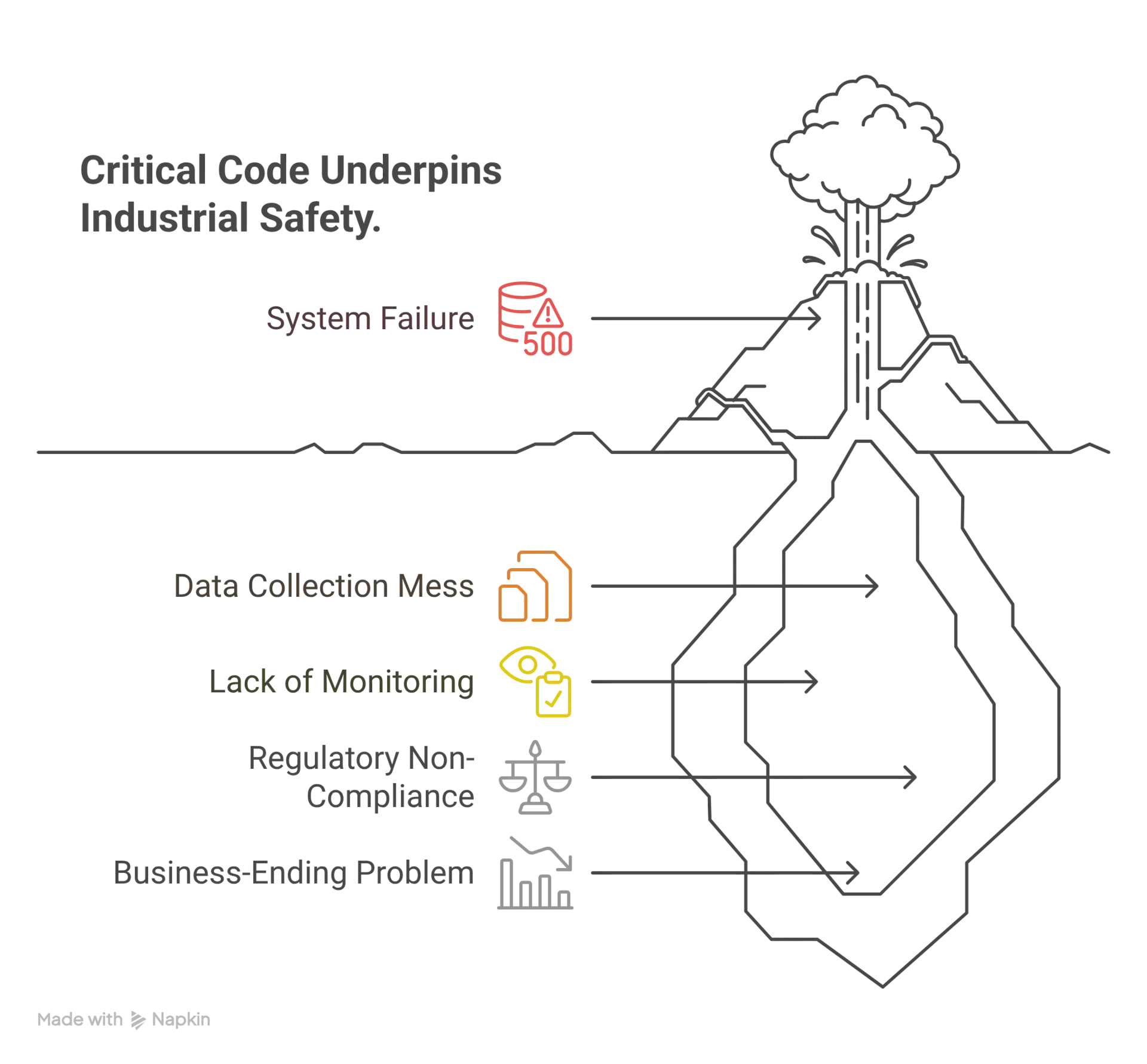
The client had sensors scattered across multiple facilities, each one critical for safety compliance. But the data collection was a mess - some sensors reported to one system, others to a different system, and some weren't being monitored at all. When regulatory inspectors showed up, they couldn't even get consistent reports. That's not just a technical problem - that's a business-ending problem.
.webp&w=3840&q=75)
.webp&w=3840&q=75)
The Legacy System That Kept Everyone Up at Night
Picture this: sensors from five different manufacturers, each with their own protocols, reporting to three different databases, with no unified view of what was actually happening. The "dashboard" was literally someone manually checking different systems and creating Excel reports.
But here's the scary part - alerts were inconsistent. A dangerous CO2 spike in Building A might trigger an email to the wrong person. A temperature sensor failure in the chemical storage area might go unnoticed for hours. The system that was supposed to keep people safe was actually creating more risk through its unreliability.
I spent my first week just mapping out what existed. It was like archaeological work - digging through layers of accumulated technical debt to understand how anything worked. Some sensors hadn't been calibrated in years. Others were sending data to servers that had been decommissioned. It was a miracle nothing catastrophic had happened yet.
Building the IoT Infrastructure That Actually Worked
The solution had to be bulletproof. When you're dealing with safety-critical systems, "good enough" isn't in the vocabulary. Every component needed redundancy, every failure mode needed handling, every alert needed guaranteed delivery.
I designed the architecture around AWS IoT Core as the central nervous system. Every sensor, regardless of manufacturer or protocol, would connect through standardized gateways. These gateways translated proprietary sensor protocols into standard MQTT messages that IoT Core could handle.
But here's where it got interesting - we couldn't just replace everything overnight. Manufacturing facilities don't shut down for IT upgrades. The new system had to run in parallel with the old one, gradually taking over responsibilities as we proved its reliability.
.webp&w=3840&q=75)
.webp&w=3840&q=75)
The Real-Time Processing Challenge
Environmental monitoring isn't like web analytics where you can process data in batches. When a sensor detects dangerous gas levels, you need alerts in seconds, not minutes. Lives depend on that response time.
I built the processing pipeline using AWS Kinesis for real-time data streaming, with Lambda functions handling immediate threat detection. But the tricky part was defining what constituted a "threat." Different facilities had different baselines, different acceptable ranges, different escalation procedures.
We implemented a machine learning component that learned normal patterns for each facility. The system could distinguish between a gradual temperature rise (maybe normal for the time of day) versus a sudden spike (potentially dangerous). This reduced false alarms by 90% while actually improving threat detection.
The Multi-Protocol Gateway Solution
One of the biggest technical challenges was handling sensors that spoke completely different languages. Some used Modbus, others used proprietary TCP protocols, some were still on serial connections. Creating a unified interface required building what I called "protocol translators."
Each gateway was essentially a mini-computer running custom software that could speak to local sensors and translate their data into standardized messages. These gateways had to be industrial-grade - they'd be deployed in harsh environments with temperature extremes, vibration, and electromagnetic interference.
The beauty of this approach was scalability. Adding a new sensor type meant updating gateway software, not rebuilding the entire system. We could support new facilities or new sensor technologies without touching the core infrastructure.
.webp&w=3840&q=75)
The Incident That Proved Everything
About six months after deployment, the system detected a gradual CO2 buildup in a storage area that the old system would have missed. The pattern was subtle - levels were rising slowly over several hours, staying just below traditional alarm thresholds.
Our machine learning algorithms recognized this as an anomaly based on historical patterns. The system triggered alerts, facility managers investigated, and they found a small leak in a CO2 storage tank. What could have become a dangerous situation was caught and resolved before anyone was at risk.
That incident became our proof point. The system hadn't just replaced the old monitoring - it had prevented an accident that the old system would have missed entirely. That's when everyone became believers.
Why This Project Still Matters
Industrial safety monitoring might not be as glamorous as consumer IoT or smart cities, but it's where IoT technology can have the most direct impact on human welfare. Every prevented accident, every early warning, every avoided regulatory violation represents real value to real people.
The system we built is still protecting workers in multiple facilities. The predictive maintenance capabilities have prevented equipment failures that could have caused accidents. The compliance automation has streamlined regulatory processes. Most importantly, the enhanced monitoring has created a culture of proactive safety management.
Looking back, this was one of those projects where the technical challenges were matched by the human impact. Building systems that keep people safe carries a responsibility that goes beyond just making code work. It's about understanding that your engineering decisions have real-world consequences.
That's what made this project special. It wasn't just about connecting sensors or processing data - it was about using technology to make dangerous industrial environments safer for the people who work in them every day. And honestly, there's no better motivation for doing your best work than knowing it might save someone's life.
Questions People Actually Ask
You know, after sharing this project, I keep getting the same questions. So here are the real answers to the things people actually want to know.